
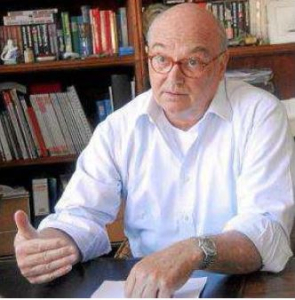
Roman Hummelt was born in Cologne in 1951, the son of Hans Graf, then captain of 1. FC Köln. After earning a degree in business administration and a doctorate on German-Eastern European joint ventures, he began his professional career in 1978 in New York at Panta Inc., the U.S. representative office of Friedrich Flick KGaA. This was followed by positions at Roland Berger and as a member of the executive board of the Waltham Group, where he was responsible for establishing subsidiaries in Central, Eastern, and Southeastern Europe for over ten years. Since 1993, he has run his own consulting firm, IMC International Management Consultants, based in Berg on Lake Starnberg.
He is the author of several business books and numerous professional articles, including for Hanser Verlag, the Handelsblatt, and the New York Times, as well as a keynote speaker at German Chambers of Commerce Abroad.
With “What can you Do? – Encounters with My Great-Aunt Sophie,” he presents his first literary work: the story of his great-aunt Sophie, a Holocaust survivor whom he got to know firsthand over the course of twelve years—a story that has accompanied him throughout his adult life before he documented it.
“When I began writing down this story, I had one main goal in mind: that my children and grandchildren would someday be able to read about who Aunt Sophie was. Not as a footnote in contemporary history, but as a strong woman with her cigarette smoke, her quick wit, and her way of silencing any braggart with just two sentences.
While I was writing this book, something has been happening around me that I could not have imagined just a few years ago. Jewish life in Germany is once again under pressure. Hardly a day goes by without a new report—a defaced synagogue, a man wearing a kippah who has been spat on. One can debate where this hatred is coming from this time, or which of its many faces it wears. What cannot be denied: It is back, visible, and it is once again targeting people who have done nothing more than practising their religion without trying to convert others.
I thought long and hard about whether, in light of this, I should have written this book differently: more loudly, more admonishingly, with a wagging finger. I decided against it. Aunt Sophie herself would probably have just shaken her head at that. She was not a woman of grand speeches. Her response to the incomprehensible was never accusation, but action—a care package, an open door for the man who had let her down, a phrase like “What can you do?” that sounds resigned and yet is the opposite of resignation: the refusal to let hatred rob her of her own humanity.
I believe that’s the only answer I can offer this book, and perhaps the only one that matters. Not because memory in and of itself prevents anything. It doesn’t, as we’re seeing right now. But because the opposite of forgetting isn’t accusation—it’s storytelling. As long as someone tells Sophie’s story—about her laughter, her determination, and her bottle of port from the year she was born—she is not an abstract victim of a bygone era. She is my aunt.”
Roman Hummelt, August 2026